
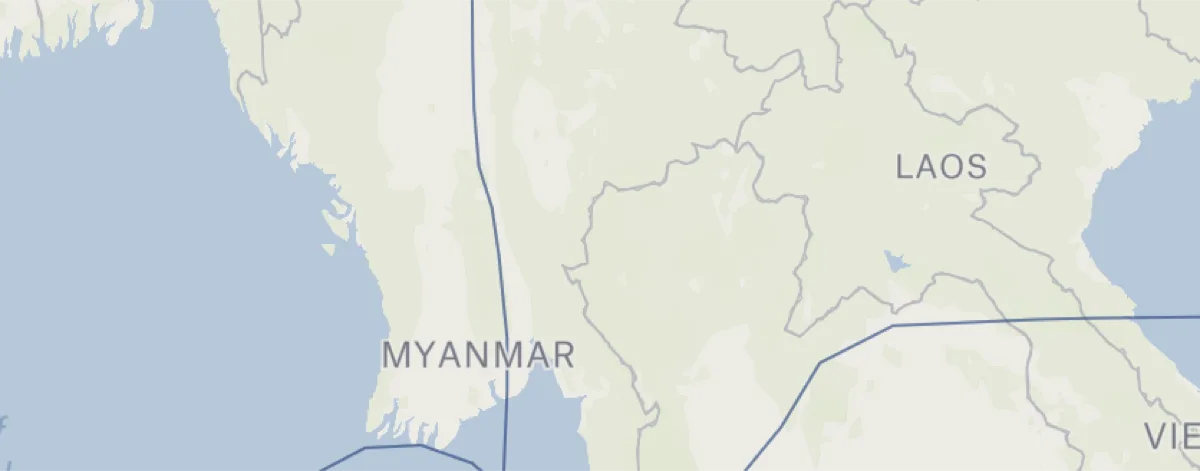
Destination IntelligenceDawei, Myanmar
Designing for a Context You Can't Control
When a coup interrupts a tourism development project mid-delivery, the question isn't whether to cancel — it's how to redesign outputs that will have value whenever conditions allow their use.
The Project That Couldn't Be Delivered as Planned
The brief was standard for this kind of work: a tourism development project in Dawei, Myanmar, commissioned by ITC, aimed at building local capacity for sustainable tourism development. Field engagement, workshops with local stakeholders, training materials, an action plan grounded in local context.
Part of the way through, a coup d'état changed what was possible. In-person delivery became impossible. The question was what to do with the work already done and the work still outstanding.
The answer was to redesign the output architecture from scratch — not to postpone delivery and wait for conditions to normalize, but to acknowledge that the window for workshop-based delivery had probably closed for an unpredictable period, and build resources that would work without it.
What "Resilient Outputs" Actually Means
The practical design shift involved three principles.
Evergreen over contextual. Content that was relevant to a specific program moment — an upcoming workshop, a scheduled stakeholder meeting, an event at a particular time — lost its value when the moment passed. Content built around durable principles — how to assess a destination's sustainability, what a code of conduct should cover, how tourism award programs work and why they matter — retained its value regardless of when it was accessed. The output design was restructured to prioritize the latter.
Self-explanatory over facilitated. Workshop materials are designed to be delivered, not read. The facilitator carries the interpretation and the context. Resources designed for independent use by someone with no prior context need to work on their own — which means more explanation, more visual structure, fewer assumptions about what the reader already knows. The video series built for this project was designed around that standard: each piece self-contained, usable without reference to the others, comprehensible to a local tourism stakeholder working through it without external guidance.
Local language as a first-class deliverable. Myanmar language versions weren't a translation afterthought — they were built as equal outputs from the start. This required involving translators in the content development process early, building layout templates that accommodated Myanmar script's different spatial requirements, and testing every animated and visual element with the script in place before finalizing. The result was materials that read naturally in both languages rather than showing the seams of a retrofit translation.
What the Package Contained
The deliverables were redesigned around this architecture:
An action plan for Dawei's tourism development, structured to remain useful as a reference document as much as an implementation guide — with enough background context that someone picking it up cold could understand the reasoning behind the recommendations.
A digital marketing guide for local tourism businesses, built for operators who might work through it independently, without training support.
A series of short video resources covering topics that retain value over time: how destination sustainability self-assessment works, what effective codes of conduct look like for both operators and visitors, how to understand and pursue industry recognition programs.
Each produced in English and Myanmar. Each designed to be actionable without external presence.
What It Points To More Broadly
Development projects in volatile contexts regularly produce materials that depend on conditions being stable enough for delivery — and become stranded when those conditions change. This is, in most cases, a design failure rather than an unforeseeable problem.
The conditions for designing resilient outputs aren't complicated: build for independent use from the start, prioritize durable content over contextual content, treat local language as a primary deliverable rather than a translation task, and design for asynchronous access from the first draft.
These choices add cost and time to the development phase. They also mean the work survives the moments when the standard delivery mechanisms fail — which, in the contexts where development work is most needed, is not as rare as project planning typically assumes.
Key Findings & Learnings from Dawei
Key findings
Evergreen Materials Outlast Disrupted Implementation Timelines
Resources built around durable principles — sustainability assessment, codes of conduct, industry standards — retained their value regardless of when implementation became possible. Time-sensitive content tied to a specific moment in the project cycle became worthless the moment that moment passed.
Digital Formats Proved More Resilient Than Workshop Delivery
Physical workshops require a time, a place, and an ability to gather. Digital resources — video, guides, self-assessment tools — require none of those things at the moment of use. Designing outputs for asynchronous, independent use wasn't a consolation; it turned out to be more useful than the original format.
Local Language Was Not Optional
Resources that could only be used by English-speaking stakeholders had limited long-term utility in a context where external support had been removed. Creating dual-language versions — including adapting visual layouts for Myanmar script — was the difference between materials that could be used independently and materials that couldn't.
Key learnings
Implementation Infrastructure Is a Project Risk, Not an Assumption
The standard project planning assumption is that delivery mechanisms will be available when needed. In volatile political contexts, that assumption should be a risk to manage explicitly — with contingency designs built before they're needed, not after.
Self-Sufficiency Is the Success Condition for High-Uncertainty Projects
A resource that requires ongoing external support to be useful will stop being useful the moment that support is withdrawn. For projects in constrained or volatile contexts, the test of success isn't delivery — it's whether outputs continue working in the absence of the people who produced them.
Translation Is an Architectural Decision, Not a Final Step
Bringing translators in at the end of a content development process produces translations that fit poorly, require visual redesign, and lose technical nuance. Involving them from the start — with space for script-length differences built into layouts, and ongoing dialogue between design and translation — produced materials that worked in both languages rather than tolerating the second.